
Understanding the Concept of Operations (ConOps) in Airport Development
Imagine designing a new airport terminal. Beyond architecture and advanced systems, the real challenge lies in ensuring the airport functions smoothly for passengers, airlines, and staff every single day.
This is where the Concept of Operations (ConOps) plays a crucial role. A ConOps defines the intended operational outcomes of an airport from the users’ perspective, providing a shared vision of how the airport should function once operational.
Rather than acting as a technical design document, the ConOps focuses on what the airport must achieve, ensuring that all future design and infrastructure decisions align with core operational goals.
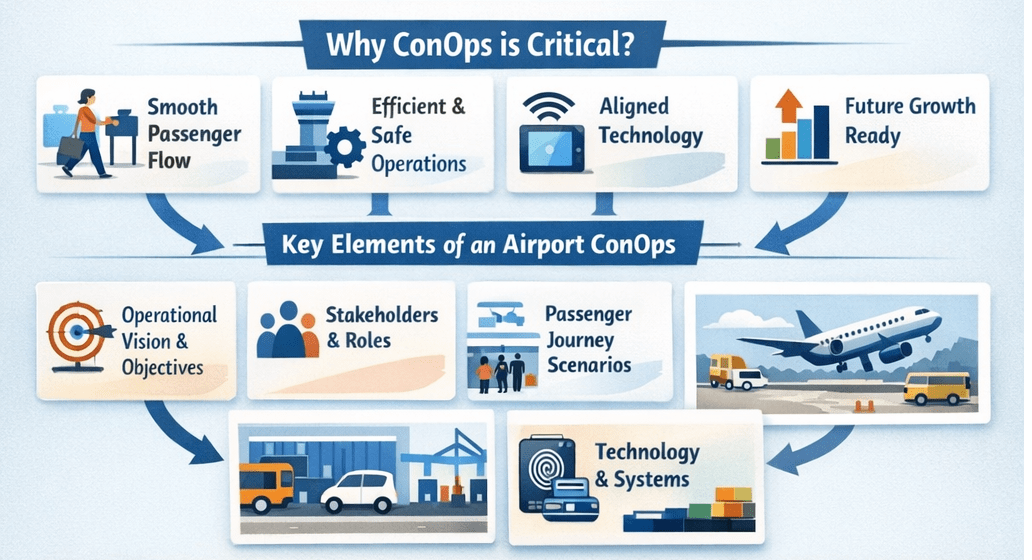
What Is a Concept of Operations (ConOps)?
A Concept of Operations is a high-level document that describes how an airport or its systems will operate in real-life conditions. It captures the needs and expectations of passengers, airlines, regulators, and airport staff in a clear and structured manner.
By defining operational intent early, the ConOps ensures that infrastructure investments result in practical, efficient, and user-friendly airport operations.
What's Inside a ConOps? The Core Components
A well-structured ConOps is built from several key building blocks that collectively define how a new or upgraded airport facility will operate. These components ensure that all stakeholders are on the same page from the very beginning.
A typical ConOps includes:
Goals and Objectives: What the airport infrastructure is expected to achieve
Operational Processes: How passengers, baggage, aircraft, and staff move through the airport
Key Assumptions: Demand forecasts, service levels, and operating conditions
Role of Technology: Systems supporting efficiency, safety, and passenger experience
Roles and Responsibilities: Clear accountability across stakeholders
Interfaces: Interaction between systems, users, and organizations
Together, these elements ensure alignment across planning, design, and operations.
Why Is the ConOps Crucial?
When it comes to safety, we leave no room for compromise. Audits act as the ultimate co-pilot, ensuring operators reach peak safety standards. By spotting non-compliances and vulnerabilities, audits become the guiding lights that lead operators towards safer skies. From enhancing risk mitigation strategies to fortifying safety protocols, it keep the public’s trust and give passengers peace of mind with every flight.
The Three Levels of a ConOps
Aviation audits/ surveilliances are the turbo boosters that rev up operational efficiency.
A ConOps is a living document developed in increasing detail across the project lifecycle.
Level 1 – Initial ConOps
Defines high-level outcomes and primary operational assumptions, such as shared or separate security screening.
Leads to: Facility and functional requirements
Level 2 – Preliminary ConOps
Introduces detailed assumptions guiding planning and design, including redundancy and alternative passenger routes.
Leads to: Facility design
Level 3 – Final ConOps
Details operational procedures used to finalize the operations manual, including access control and queue management.
Leads to: ORAT and Operations Manual
ConOps in Action: Passenger Check-In Journeys
To make a Concept of Operations practical and genuinely user-focused, it is often structured around journeys—specifically the journeys of passengers, baggage, and airport staff. This approach allows planners and decision-makers to understand how operational outcomes unfold at every stage of the airport experience.
One of the clearest examples of how ConOps decisions influence airport design and operations is the check-in process. While check-in may appear to be a simple activity, the assumptions made in the ConOps can lead to vastly different operational models, each with its own physical layout, technology requirements, staffing levels, and passenger experience.
High-Technology, Efficient Check-In Model
In a high-technology deployment, the ConOps is built around the assumption that passengers will complete as many steps as possible before arriving at the airport.
Passengers are encouraged to check in remotely using airline websites or mobile applications and arrive at the airport with a digital or mobile boarding pass already issued. Biometric technologies—such as facial recognition—may be introduced to support a seamless, touchless journey through check-in, bag drop, and security.
To further reduce congestion inside the terminal, off-site check-in and bag drop facilities may be provided at locations such as city terminals, hotels, or transport hubs. This allows passengers to travel lighter and arrive at the airport closer to departure time.
Inside the terminal, check-in counters are designed to be flexible and shared. Any passenger can use any available desk, and many counters may operate as self-service units without permanent staffing. This approach significantly improves space utilization, reduces queue lengths, and allows the airport to handle peak demand more efficiently.
This model is particularly well suited to:
Large international hubs
Airports with high passenger volumes
Tech-savvy passenger markets
Airports focused on speed, efficiency, and scalability
Traditional, Low-Technology Check-In Model
In a more traditional deployment, the ConOps assumes that most passengers will complete the entire check-in process at the airport.
Passengers arrive at the terminal without having checked in online and must visit airline counters to obtain boarding passes and complete document checks. Airlines typically operate dedicated check-in desks, with little or no sharing between carriers.
The absence of self-service kiosks or automated bag drop systems means that airport staff play a central role in the process. Travel documents, seat assignments, baggage acceptance, and ancillary services are handled manually by airline agents.
While this approach may require more terminal space and staffing, it can be appropriate for airports where passengers expect higher levels of personal assistance or where technology adoption is limited.
This model is often suitable for:
Regional or smaller airports
Airports with low passenger volumes
Markets with less digital adoption
Operations prioritizing personalized service
Planning for the Unexpected: ConOps and Irregular Operations
A resilient airport is one that can manage disruptions effectively. Therefore, a robust ConOps must plan not just for the “normal day” but also for resilience by addressingirregular operations. Developing a ConOps for these situations is about planning for the “what ifs?” to identify the infrastructure and systems needed to deliver operational resilience when things go wrong.
To better inform planning, these irregular operations can be categorized along two critical axes: theirPredictability of Impact (from easy to difficult to predict) and their Duration of Impact (from short-term to long-term). This framework helps airport managers develop different strategic approaches for different types of risks.
High Predictability / Short Duration
These are frequent, short-term disruptions that can often be managed with well-rehearsed plans. Examples include:
- On-airport system outages (e.g., baggage system failures)
- Regular weather events (e.g., snowstorms, low visibility)
- Holiday and pilgrimage peaks
High Predictability / Long Duration
These are foreseeable trends or events with long-lasting impacts that require strategic, long-term planning. Examples include:
- Climate change events (e.g., sea-level rise)
- Major airline bankruptcy
- Economic recession
Low Predictability / Short Duration
These are sudden, unexpected events with a relatively short impact, requiring rapid response and contingency plans. Examples include:
- Off-site system failures (e.g., power grid outage)
- Security incidents or fire
- Extreme natural events
Low Predictability / Long Duration
These are rare, high-impact “black swan” events that can fundamentally alter the operating environment for a long time. Examples include:
- Pandemics
- Major security or terrorism changes
- Significant political change
By structuring its planning around these categories, the ConOps ensures the airport is designed to be as robust and adaptable as possible.
Conclusion: Key Takeaways for Future Airport Managers
Ultimately, a Concept of Operations is the strategic narrative that describes how an airport will function, ensuring that billions of dollars in infrastructure investment result in a facility that truly serves its users.
For any student of aviation management, here are the three most critical takeaways:
- It’s About ‘What,’ Not ‘How’:The primary role of the ConOps is to define the desired operational outcomes (the “what”). It leaves the specific design solutions and technologies (the “how”) to be determined in later project stages, guided by those outcomes.
- It’s a Crucial Link:The ConOps is the indispensable bridge that connects high-level strategic goals with the practical, on-the-ground design and

Suvrita Saxena is an Aeronautical Engg with added qualification as EMBA( HRM) , ISO lead Auditor and Diploma in Cyber Law.Suvrita has started the journey in DGCA in October 1992. Worked in Airworthiness Directorate for 11 Years, Air Safety for 07 Years and Presently as Director Operation leading Directorate of Training and Licensing, Aerodrome Standards and FSD for Western Region of India. She has exposure in multi department/ wings of DGCA. She has also done ICAO course on Civil Aviation Master Planning.